


On Sunday, the 2025 College Football Playoff bracket was revealed.
Following the announcement of Tulane as the #11 seed AND James Madison as the #12 seed, plenty of pundits lost their collective minds.
First off, it appears many of them were unaware of the rules in which the CFP’s 12-team iteration was founded on. The top five ranked conference champions were always required to be included. With four power conferences, the expectation was that each of their conference champions would be included, plus the top ranked champion from the rest of the FBS conferences. This came after a stretch of time where roughly 60% of the sport was excluded from playing for a championship no matter how many games they won.
Due to some wacky tiebreaking procedures in the ACC, Duke (7-5) met Virginia (10-2) in the title game instead of Miami (10-2). After the Blue Devils pulled off the upset, the door was opened for not one but two teams outside of the Power 4 conferences to be included.
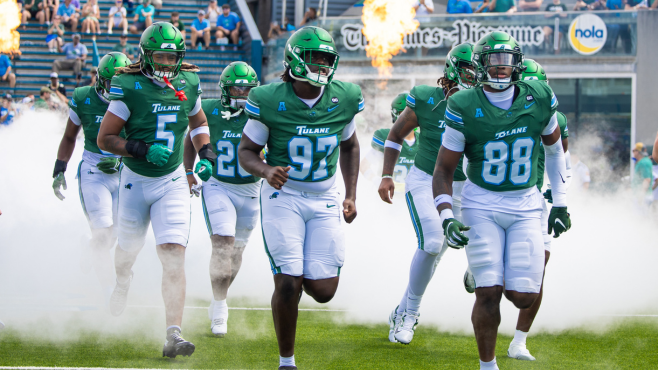
And that leads us back to Sunday. With Tulane taking the #11 seed as the fourth highest ranked conference champion, and James Madison the #12 seed as the fifth champ.
The criticisms came from all over, but plenty of them lack good foundations. Let’s examine a few.
“The Group of 5 is undeserving of having two representatives.”
Well, the irony in this criticism is that the system was basically set up to prevent this from happening. The original format called for the top six rated conference champions. However, once the PAC-12 mostly dissolved, they amended the rules to only make it the top five. In theory, the SEC, Big Ten, Big 12, and ACC Champions would be in every year. Then, the highest ranked Group of 5 Champ would take the last automatic bid. As a result of convoluted and downright silly tie-breaking procedures, the ACC sent 7-5 Duke to the title game instead of 10-2 Miami. When the Blue Devils pulled the upset, the league boxed themself out of the auto-bid, opening the door for JMU. So, in actuality, maybe there should not be two every year. But it is literally the fault of the power conferences in this instance.
“Tulane and JMU will just get blown out, so what’s the point?”
Ahh, perhaps my favorite. Why would America want to see these two little teams get blown out of the water instead of some good matchups! Well, first of all, underdogs winning games is one of the most entertaining and endearing premises in all of North American sports. Like, they literally make movies about them. Secondly, the College Football Playoff has been quite actually FULL of blowouts since its inception. And almost all of them have featured power conference teams blowing out power conference teams.
Some examples: As Tom Fornelli points out, no G5 teams played in the First Round of the CFP last year (Boise State had a bye). In the four games featuring all P4 teams, the average margin of victory was 19.25 points. The Tulane-Ole Miss spread is less than that.
More specifically, Tennessee (SEC) lost by 25, and SMU (ACC) lost by 28. So sure, Tulane and/or JMU might get blown out. I did not hear anyone complaining that Tennessee got into the field last year.
“These schools can’t compete with their lack of resources, so what’s the point?”
This is a fun one, because in some ways I actually agree with the premise! It is incredibly difficult for these smaller programs to fight up in weight class without the funding that teams in major conferences got. However, it makes it that much more impressive when they find ways to still compete. Moreover, having a path to the playoffs potentially begins to level the playing field over time. How awesome would it be if 100 teams across the country genuinely had a chance to compete for a title in any given year? Sure, we are a long way off from that. However, making the path possible is the ultimate equalizer to making college football a truly special nationwide sport.
What this all comes down to is a fundamental conversation about what college football is going to look like in the future.
Clearly, there is a threat that the two most powerful conferences will turn into a super-league and model themselves into NFL Jr. And plenty of people think that would be a good thing.
I think it would be awful.
The NFL is what it is because it is the highest level of football and a collection of the best athletes on the planet going at it every Sunday. A watered down version of that on Saturdays is simply not what I am looking for.
Rather, I prefer the paegentry, tradition, and magic of college campuses across the country gathering to cheer on their teams with unique elements in each area.
Including teams from all FBS conferences continues to support what college football has always been about, even in a new era with player benefitting from the money that the sport provides.
Dawson Eiserloh is the host of “The LohDown with D-Loh” which is broadcast weekdays (1-3 PM) on ESPN 103.7 Lafayette and 104.1 Lake Charles — Southwest Louisiana’s Sports Station