

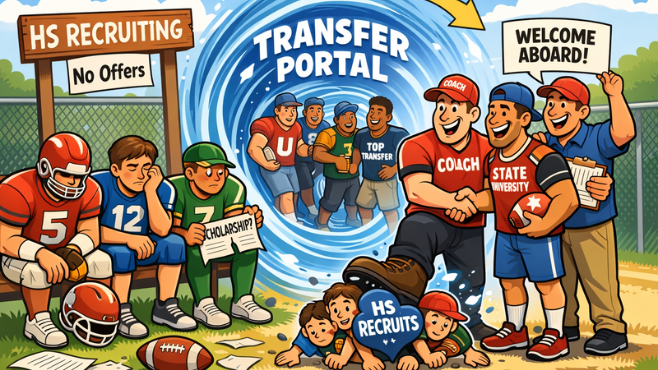
The NCAA transfer portal has become the lifeblood of college football programs.
If a program wants to earn a berth in the College Football Playoffs and compete for the ultimate prize — a national title — then you must raid the portal with no mercy.
The eight teams that advanced to the College Football Playoffs quarterfinals feature high-profile transfers, including quarterbacks Carson Beck (Miami), Julian Sayin (Ohio State), and Heisman Trophy winner Fernando Mendoza (Indiana), and wide receivers Germie Bernard (Alabama) and Zachariah Branch (Georgia).
There will be thousands of players changing teams when the portal window opens on Friday. In fact, there will be entire rosters of teams in the portal. Due to head coaching changes, Iowa State has 47 players in the portal, Oklahoma State has 45, and Auburn has 25. James Madison University, which made the CFP out of the Sun Belt, has lost all 11 of its offensive starters to the portal due to the coach’s leaving.
This is the new normal.
There is no doubt that you have to become experts in navigating this new world of the portal and NIL collectives. This has made college football a world of never-ending chaos.
It also has a devastating impact in another arena; the transfer portal has killed high school recruiting.
For decades, college football programs recruited and signed multiple three or two-star players because of their potential. They would spend months, if not years, tirelessly molding those lesser heralded recruits into becoming multi-year starters. Through extensive coaching, weight training, and nutrition regimens, those players would earn playing time first as backups or special team players and then eventually as starters.
Now? Those players are no longer being considered for being offered scholarships — unless you are a blue-chip prospect that has been getting attention for two to three years.
The majority of FBS programs, in particular the top-tier schools in power conferences, are no longer focused on taking the freshman players with potential.
Instead, programs have rapidly turned to the 21-year-old player from a Group of Five program or even an FCS or Division II team who has already been developed by another staff. These are ready-made players who are hopefully already prepared to contribute as impact starters.
That has a trickle-down effect as well, as those Group of Five teams are forced to replenish their coffers by poaching kids out of the transfer portal from the FCS level, Division II or III, or even NAIA. As they say, everything rolls downhill.
With NIL collectives and mega boosters openly bankrolling programs, the sport of college football is a billion-dollar industry with a win-now mentality. There is no time for developing a quarterback or defensive back who is not given a blue-chip distinction by Rivals or 247 Sports.
If you want to take a chance on a lesser prospect? Then you’d better have an athletic director who has your back and a booster willing to be patient. If not, they will simply pay you to go away and throw ungodly amounts of money at someone else to win immediately.
With coaching staffs having to switch from long-term project building to viewing players as assets in a hostile Wall Street takeover, high school recruiting has simply been cast aside.
There is something truly shameful about that.
Yes, major programs are still signing three stars. USC, LSU, and Alabama all signed three-star recruits during the early period. But the priority has shifted for most programs to the portal.
Think about the under-recruited players that took a little longer to transform into star college players, and then NFL legends.
Travis Kelce and his Super Bowl-winning teammate, Patrick Mahomes, were two and three stars. Two-time NFL MVP Lamar Jackson and three-time Defensive Player of the Year Aaron Donald were also three stars, as was one of the best players to ever come out of Louisiana.
Justin Jefferson was a three-star out of Destrehan High and wasn’t even a Top 50 prospect in Louisiana. He would go on to become an All-American, National Champion, and multiple All-Pro. Not bad for a kid who was considered the 275th-best wide receiver in the country.
In this new era, all of those players would have started out elsewhere and likely not been given a chance to develop with one team.
There is plenty of blame to go around, including administrations, coaches and even fan bases who collectively don’t have the patience for developing players.
If someone doesn’t play right away, his parents and agent are urging them to hop into the portal. If players don’t play up to standards, then coaches go into the portal to find someone better.
The high school players that are no longer getting phone calls or visits from college coaches are still as deserving of earning a scholarship as an older player who is in the portal. They simply need an opportunity.
It is common in this modern era to have apathy about people getting a fair shake in any realm of life, much less sports. It is simply easier to accept that money drives all decisions.
I mean, who has time to be upset by such things when you are rooting for your team to win national titles?
But there is something undeniably admirable and maybe old-fashioned about a program and a player coming together to commit to each other for years to come. That is a bond that develops, which means more than NIL paydays.
The transfer portal may be revitalizing title contenders, but it is coming at the expense of high school players. That shouldn’t be the new normal.
Raymond Partsch III is the co-host of “RP3 & Meche” which is broadcast weekdays (11-1) on ESPN 103.7 Lafayette and 104.1 Lake Charles — Southwest Louisiana’s Sports Station.