

By JOHN MARCASE
Written for the LSWA
Thirty years after hitting the biggest home run in college baseball history, Warren Morris is still amazed at the impact.
“I had no clue that it was gonna be something where strangers would come up to me all the time and tell me, I remember where I was, I was doing this, or, you know, I was at this wedding,” said Morris. “It’s kind of like a moment in time; people remember where they were.”
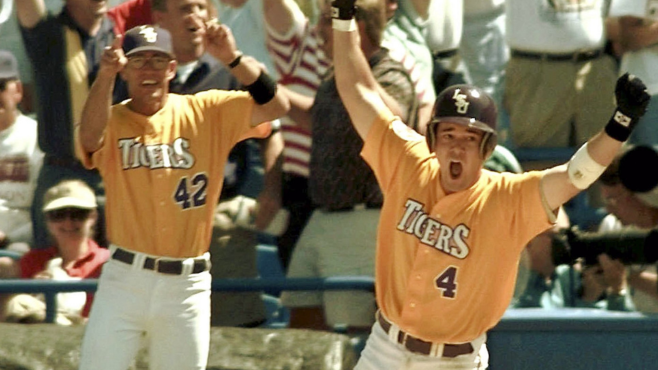
The moment: Championship game of the 1996 College World Series. LSU trailed Miami, 8-7, with two outs in the bottom of the ninth inning and the tying run on second base. Morris, batting last in the LSU lineup due to a hand injury and subsequent surgery, had not hit a home run that season. Until then. Morris attacked the first pitch from Miami closer Robbie Morrison. The line drive just sailed over the right field wall.
Morris’ life changed with that one swing. But, as anyone who has known Warren Morris before he stepped into the left-handed batter’s box at Rosenblatt Stadium for the final time on June 8, 1996, will attest, that one swing did not change him.
“Warren Morris was a great kid before he hit that home run,” said Steve Boniol, Morris’ first baseball coach, “and Warren Morris would’ve been the same had he struck out. He has not changed.”
That is one of the reasons Morris is being recognized as the third recipient of the Louisiana Sports Hall of Fame’s Louisiana Sports Ambassador Award, established in 2020. The award honors long-term exemplary contributions to the perception of Louisiana by an individual who has ties to the state’s sports landscape.
He won’t bat flip but he will be roundly cheered Saturday, June 27 when he is part of a 12-member Class of 2026 inducted in the Hall. The ceremony at the Natchitoches Events Center culminates three festive days with seven events, including a June 26 bowling party in his hometown of Alexandria. For 2026 induction participation info, visit LaSportsHall.com or call 318-238-4255.
Morris’ former offseason workout partner called to congratulate him upon hearing the news.
“I told him that in a way, that’s even better than what I got, because they put me in on what I did on the field,” said Russ Springer, who was inducted into the Louisiana Sports Hall of Fame in 2018 after 18 years in the majors following a stellar career at LSU, “but they thought he was a good enough person and all the things he did outside of the field that you deserve this award.”
“When he said it, I was like well that’s pretty cool coming from him, and it is a cool way to look at it,” said Morris.
How Morris ended up as a member of the Louisiana Sports Hall of Fame would be a storybook tale, only if he hadn’t already been subject to an SEC Network documentary, “The Walk Off.”
To adequately comprehend how Morris got to this point in his life would need a series, not just a one-off, one-hour production.
“If you would have told the 9-, 10-year-old me, go ahead and just dream big,” said Morris, “I would have sold myself way short. All of this is just way beyond anything that I thought I was even capable of doing.”
The 9-year-old Morris would’ve told you he was gonna be a basketball player. After all, that was his favorite sport, and his dad, Bill, was the high school coach at Bolton High School in Alexandria. That was when fate intervened for the first time.
Steve Boniol’s son, Scott, and Warren were best friends. Scott’s Dixie Youth Baseball team, coached by Steve, needed an extra player. Steve had to talk Bill and Barbara Morris into letting Warren play baseball. Steve and Scott Boniol took Warren to his first practice, but first, they had to stop at Steve’s store, Cenla Sports, to get Warren a glove.
“The first practice, I threw batting practice and he would miss every time,” said Boniol. “I told my assistant, Billy Moore, to teach Warren how to bunt. Warren had a work ethic, and he wasn’t going to settle for not being able to hit. By the end of the season, Warren led the team in hits.”
The valedictorian of his graduating class, and an All-State infielder, Morris wound up accepting a walk-on invitation to join the LSU baseball program, and then promptly redshirted his freshman year as three-time All-American and all-time LSU great Todd Walker was firmly entrenched at second base. Yet, that year he sat out proved pivotal thanks to longtime Skip Bertman assistant Smoke Laval.
“I don’t think it’s by accident that was the only year that Smoke Laval was there,” said Morris. “Smoke would notice little things, and I don’t know if he sensed that I wasn’t so sure of myself, but I guarantee you that at least once a week, he would just come by and talk to me. And, he would always tell me, because Todd Walker was playing ahead of me, that one day, that’s gonna be you. You’re gonna play here. You’re good enough.
“I started believing it. You never know how someone in your life makes a big difference.”
The following season, Morris started 63 of 66 games as an outfielder. Then, he succeeded Walker as the starting second baseman and earned second-team All-American honors. Heading into his fourth year of college and third as an every-day player, Morris was a preseason All-American and likely member of the 1996 U.S. Olympic team.
Then, fate intervened again.
His right hand felt uncomfortable during the fall of 1995, and it never improved as the 1996 season began. Eventually it was discovered Morris had fractured the hamate bone and would need surgery. It forced him to miss 39 games, and it caused many frustrating moments. Yet, it may have been the best thing that ever happened to him.
“I mean, obviously, at the time, I wasn’t enjoying it, but looking back, it kind of goes back to God’s got a plan,” said Morris. “You don’t understand it, but it turned out better in two ways.”
The first was Morris surrendered to God’s will. If he could return to baseball he would. If his career was finished, he was content to graduate and move on with his life’s calling.
“I still go back to being alone in my apartment, closed the door, just got on my knees, and I prayed,” he said. “I said, God, I can’t do it anymore. I don’t know what you want me to be. I’m not worrying about it anymore because I don’t have any answers … but if you want me to keep playing, then I’ll do that and give you all the glory, but I’m not worrying about it anymore.”
The second part paid dividends on the field. The injury and post-surgery recovery changed Morris’ swing. He went from a player who threw right-handed and was a contact left-handed hitter, to a hitter who could really start driving the ball when he made contact.
“When everybody else was practicing, I would go in the cage with my one good hand, which is my non-dominant hand, and I hit so many balls, like I’d never focused on just my left hand,” he said. “Whenever I had the surgery, I came back and I’m really driving the ball with my top hand and I’m hitting it better than I ever did before.”
Morris returned to the LSU starting lineup on May 16, hitting ninth.
Had he never been injured, he would not have been in position to hit his walk-off homer in Omaha. As it turned out, LSU won all 22 games he started that season.
Had he never been injured, Morris likely would not have been the best player on the 1996 U.S. Olympic baseball team that won bronze. He led the team in average (.409) to go with five homers, 11 RBI and 10 runs scored in nine games.
Had he never been injured, Morris admits, he may never have made the major leagues, finishing third in NL Rookie of the Year voting in 1999 when he hit 15 home runs.
“The Olympics were right after the injury and I led the Olympics in slugging percentage, which is crazy, but I think that never happens if I don’t have the injury,” he said. “I mean, that’s crazy to say, but I don’t know if I have a major league career if I don’t have that injury, because I don’t think I was good enough in power and the things they want you to do when hitting.”
Morris retired from baseball in 2006. He and his wife, Julie, settled in Alexandria to raise their three daughters. Morris eventually took a job working for Red River Bank.
He took another job in an unofficial capacity – perhaps the best ambassador LSU baseball or college baseball could have. Each June, there are calls from across the country wanting to relive 1996. He has been invited to speak to numerous civic organizations, businesses, churches and to countless sports teams, motivating players that if it could happen to Morris, it could happen to one of them. A true genuine role model.
“The only thing Warren ever did wrong was return a videotape to Blockbuster without rewinding it,” joked Bertman. “This happened not once, but twice when Warren was at LSU …. a clergyman told me thanks for sending Warren by our church. And I didn’t send him. He went on his own both times. He’s a humble kid, a wonderful kid.”
“He provided the greatest moment in the history of the College World Series 30 years ago, and he since has embodied the values of a devoted husband, father and community leader,” added Bill Franques, LSU’s baseball communications director since 1989. “LSU is very grateful for the lifetime impact Warren Morris has made upon our state.”
The only irony about Morris’ journey since June 7, 1996, is his three daughters were never into sports. They know he played baseball at LSU but as far as his impact on this state’s sporting history? Even as LSU students, it took a sorority sister’s family for them to finally comprehend.
“As luck would have it, one of the girls they’re kind of partnered with in their sorority, her parents are huge LSU sports fans,” Morris said. “After talking with this girl for about two months, something came up about me and she was blown away. She was like, that’s your dad? We have a poster of him in our house!”
Now, Morris is taking it to another level as a member of the Louisiana Sports Hall of Fame as the Louisiana Sports Ambassador. From a teenager who had doubts he could play at LSU to someone who wondered if anyone would talk about his title-winning homer.
Thirty years later, Louisiana is still celebrating it, and Morris. Chances are, Louisiana will still be talking about Warren Morris 30 years from now.
One thing is for certain, though, he will still be the same Morris everyone in Alexandria knew long before he stepped foot on campus at LSU.
“He is Warren Morris,” said Boniol. “He has never changed. I give credit to his mom and dad. He is top notch and there are not too many like him walking around.”