


MILWAUKEE, Wisconsin — I had my Ray Kinsella moment.
There I stood in a place many consider sacred ground, and yes, it was in the Midwest. It was here that I heard a voice. Unlike my fellow Ray, who heard, “If you build it, he will come,” like he did in “Field of Dreams,” I thought I was going a tad crazy, or at least maybe I had enjoyed one too many cold brews.
Yet, I heard it again, and it was not a whisper that was uttered. Instead, it was a fairly loud and salty voice with a slight Cajun accent that I heard in my head — to be more specific, it was that of my friend Glenn Quebedeaux.
Queb was not telling me to wipe out acres of corn to build a baseball field for ghosts, either. Instead, I simply heard one name, “Howie Ferguson.”
Immediately, I recalled Queb telling me stories about this tough-as-nails guy from New Iberia, who, despite not playing a down of college football, made his way to the NFL and played for the Green Bay Packers. He was such an impact player in the 1950s that he was actually inducted into the Packers Hall of Fame.
All of that came rushing back to me as I stood inside the Packers Hall of Fame in Green Bay. That was a relief, because it meant that being in that place and time triggered a memory, and not an indicator of my mental health rapidly declining or me drinking too much.
I was in the great state of Wisconsin for a guy’s weekend trip with one of my best friends, Shawn Finney.
We had kicked off the trip with the Miller Beer Tour, then watched a Milwaukee Brewers game where folks were tailgating for a Thursday afternoon game, mind you. Of course, we made sure to pay our respects to the statue of the late great Bob Uecker.
After spending four days in Wisconsin, their penchant for drinking, eating sausage, sports fandom, and distinct accents felt a lot like Louisiana — minus the stifling humidity.
We also made the trip to Madison and Camp Randall for a University of Wisconsin football game, and were concluding it with a trip to one of the historic cathedrals of American sports — Lambeau Field.
We enjoyed walking around the Titletown area outside of the stadium, and the weekend of eating brats, drinking cold brews, and eating all types of fried cheese continued. We tried to get the Original Butter Burger at Kroll’s West, but it was so packed (not to worry, we did go back after the game, and it was tasty). We had some free time, so we decided to go check out the museum inside Lambeau.
There are hundreds of artifacts of the famed franchise’s legendary gridiron success. There is the massive championship banner from the 1936 season, display cases of Packers equipment over the decades, a spotlight of the most recent Pro Football Hall of Famer, Sterling Sharpe, and then, nestled around the stairwell leading up to the second floor, is a room for the Packers Hall of Fame Inductees.
That room leads into another area of lockers of all the team’s Pro Football Hall of Famers, such as Bart Starr, Paul Hornung, Reggie White, and Louisiana Sports Hall of Famer and Grambling State legend Willie Davis, to name a few. Beyond that are all the championship trophies, including the four Lombardi Trophies.
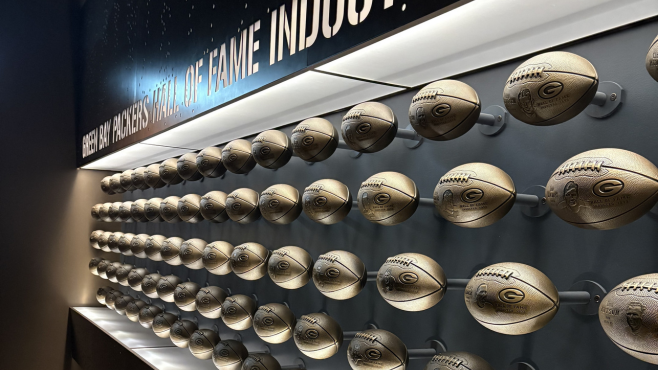
It was phenomenal, but it was while I was walking back that I stopped to look at the walls of bronzed footballs, each one representing a Packers Hall of Famer. Amongst the names were Starr, Hornung, Jerry Kramer, Ray Nitschke, Reggie White, and Brett Favre.
That’s when I heard Queb’s voice, and after a few minutes of reading the names on the footballs, I found Ferguson. My intrigue was piqued, but I had to scoot out and get into our seats for the game. During some downtime, I wondered how many people wearing Jordan Love jerseys and wearing cheese heads knew of Ferguson. Probably not many of the “bros” sitting behind us who could barely formulate the phrase “You suck, Jared Goff” were likely to know about the Louisiana boy who was enshrined into the team’s Hall of Fame in 1974.
But the next day, after exploring downtown Milwaukee while killing time before my flight home, I began to do research on Ferguson. To be more exact, I did research after taking the tour, Best Place at the Historic Pabst Brewery. I mean I had to bookend the trip the right way after all.
Ferguson’s story is fascinating.
He was a standout in football, basketball, baseball, and boxing at New Iberia High School. Instead of going on to college, Ferguson enlisted in the United States Navy. After proudly serving his country, he was discovered by a scout of the Los Angeles Rams but was cut. He landed in Green Bay and became known for his tough and relentless running style, earning the nickname, “The Bayou Bronco,” from a reporter of The Milwaukee Journal.
In six seasons for the Packers, Ferguson, who spent his offseason working as a rigger in the oil fields of Southwest Louisiana, played in 65 games, rushed for over 2,100 yards, and averaged 3.9 yards per carry. He earned Pro Bowl honors in 1955 after piling up more than 1,000 yards combined rushing and receiving.
During his time, the Packers were not good, and eventually, with multiple injuries piling up, Ferguson’s career came to an end in Green Bay as he played for Vince Lombardi in 1958, alongside future Hall of Famer and Louisiana native Jim Taylor.
He came back to football in 1960 for the Los Angeles Chargers of the AFL, helped them win the Western Championship, and averaged a healthy 3.5 yards per carry. A detached retina in the AFL Championship Game would end his career for good, and Ferguson returned home to New Iberia, started a successful oil field company.
How many folks are unaware of Ferguson’s story? Hopefully more now, but what this trip also showed me is how so many of our former Louisiana sports legends are being forgotten. Negroes League legend John Richard Wright, Glenmora High and Centenary star Eddie “Touchdown” Townsend, and trailblazing jockey Abe Hawkins are just a few of the state’s stars who are fading away.
Having played in the era predating television, when athletes were only known due to radio and daily newspapers, is part of the reason. The other reason is that as years become decades and decades become generations, those who remember the former stars fade away, too. Those stories are no longer passed down, and we forget.
Thankfully, yours truly had an older Cajun friend who shared the story of one of Louisiana’s forgotten legends.
Raymond Partsch III is the co-host of “RP3 & Meche” which is broadcast weekdays (11-1) on ESPN 103.7 Lafayette and 104.1 Lake Charles — Southwest Louisiana’s Sports Station.